

Your First Decisions as a Gaming Content Creator
Starting a gaming content channel requires four decisions before the first upload. These are content type, platform, equipment, and channel setup. Most beginners start with gear and editing software instead. That order wastes money and causes early channels to stall within the first three months.
This guide walks through each decision in order. Every section links to a deeper Manabrand resource for readers who want more detail on a specific step.
Key Takeaways
- Content type comes before platform: decide what to make, then where to publish it.
- YouTube, Twitch, and Kick use different discovery mechanics and monetization thresholds.
- A niche can develop after the first uploads. It does not need to exist on day one.
- A minimum viable setup costs far less than most beginners assume.
- One focused channel outperforms several channels split thin.
- → What type of content do you want to create
- → Which platform should you start on
- → Do you need a niche before you start
- → What equipment do you actually need at the start
- → How to set up your channel the right way
- → One channel or several: where to focus first
- → Common mistakes beginners make
- → What's next: your path to the creator brand blueprint
What Type of Content Do You Want to Create?
Content type determines every decision that follows it. It sets the platform, the equipment, and the production workflow. Two broad categories exist for gaming creators: live streaming and recorded video. Each has a different relationship with the audience and a different time commitment.
Streaming vs. Recorded Video
Streaming happens in real time. Viewers interact through chat, and the content exists once, during the broadcast. Recorded video is edited before publishing. It allows retakes and cuts, but takes longer to produce per minute of finished content.
Streaming
Format:
Live, real-time
Editing required:
Minimal
Audience interaction:
Real-time chat, playing together
Consistency needed:
Fixed schedule
Recorded Video
Format:
Edited, pre-recorded
Editing required:
Significant
Audience interaction:
Comments, delayed
Consistency needed:
Regular upload rhythm
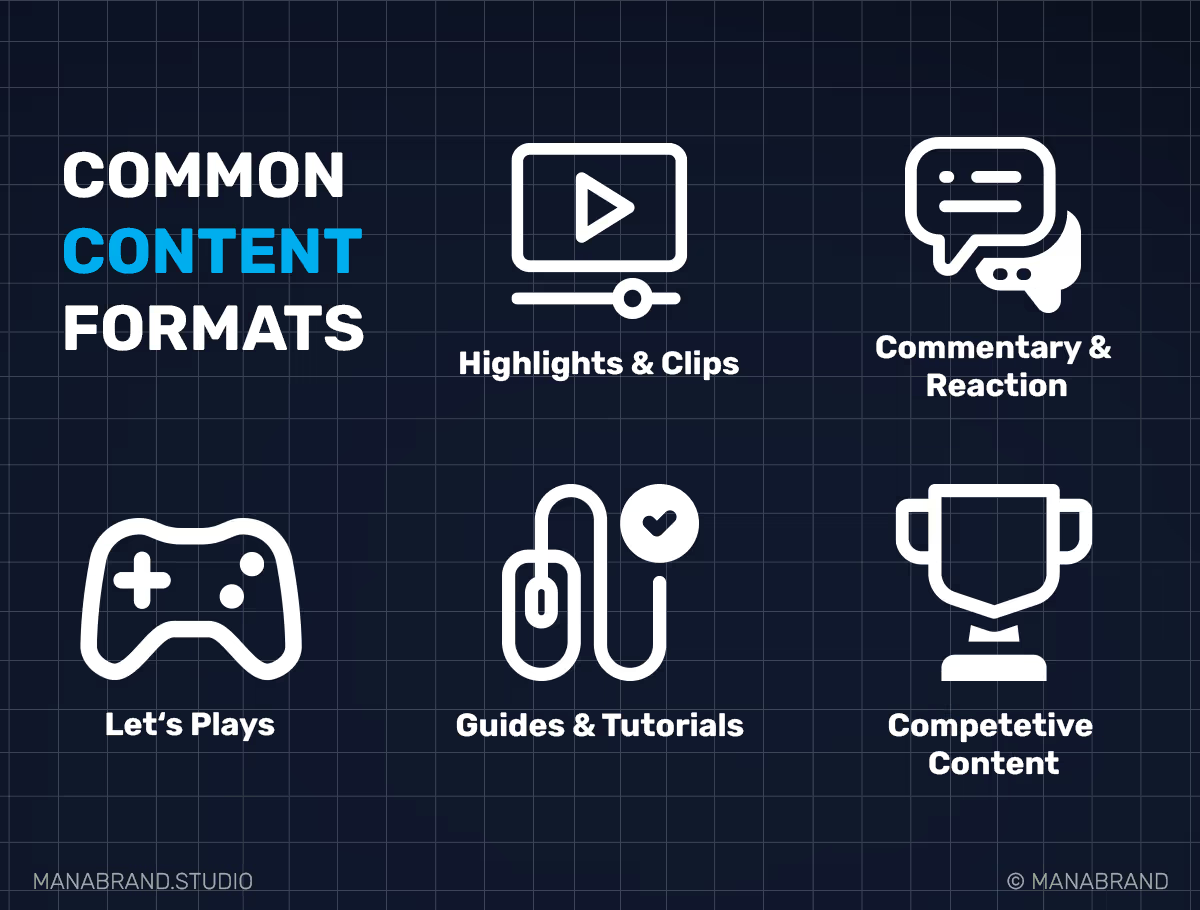
Common Content Formats for Gaming Creators
Format is a separate decision from content type. Both streaming and recorded video support several formats, and each format fits a different audience and skill set.
- Let's Plays: Full or partial playthroughs with commentary.
- Guides and tutorials: Step-by-step instructions for a specific mechanic or strategy.
- Highlights and clips: Short cuts from longer streaming or gameplay sessions.
- Commentary and reaction: Analysis or reaction to games, industry news, or other creators' content.
- Competitive content: Ranked matches, tournament coverage, or esports analysis.
Most creators start with one format and expand later. A narrow format is easier to produce consistently than a broad mix.
Which Platform Should You Start On?
Platform choice depends on content type and discovery mechanics. YouTube, Twitch, and Kick each reward different behavior, and each has a different entry point for monetization.
YouTube
Content Fit: Recorded video, Shorts, Live streaming
Discovery Engine: Search and recommendation algorithm
Monetization Entry Point: 500 subscribers, 3 uploads in 90 days, plus 3,000 watch hours in 365 days or 3M Shorts views in 90 days
Kick
Content Fit: Live streaming
Discovery Engine: Category browsing, lower competition
Monetization Entry Point: 250 followers, 25 active subscribers, 30 hours streamed and 250 unique chatters in 30 days
Twitch
Content Fit: Live streaming
Discovery Engine: Category browsing, raids
Monetization Entry Point: 25 followers, 4 hours streamed across 4 different days, average 3 viewers
The entry tier above unlocks fan funding on YouTube: channel memberships, Super Chat, and Super Thanks. Full ad and YouTube Premium revenue needs a higher bar: 1,000 subscribers, plus 4,000 watch hours in 365 days or 10M Shorts views in 90 days, rising to 8,000 hours or 20M views from February 1, 2027.
Twitch Affiliate status above does not require Partner-level reach. Twitch Partner is the next tier: six streams averaging 75 or more concurrent viewers, in each of two consecutive 30-day periods, tracked through Twitch's Path to Partner progress.
YouTube rewards consistency and search-optimized titles over months. Twitch and Kick reward real-time interaction and live discovery. Recorded video creators typically start on YouTube. Streamers typically start on Twitch or Kick.
TikTok, Instagram Reels, and YouTube Shorts serve a different purpose. They are not home platforms for a gaming channel, but they extend the reach of content already published elsewhere. Clips and highlights repurposed from a stream or video reach new viewers on these platforms without a separate content strategy.
Platform choice is a starting point, not a long-term commitment. Platform Independence for Gaming Creators covers why no single platform should carry the full audience relationship.
Do You Need a Niche Before You Start?
No. A niche can develop after the first uploads. Most successful gaming channels find their niche through early content, not before it.
Publishing a range of content within gaming reveals which topics get traction. A niche imposed too early is often based on guesswork instead of data. A niche becomes worth defining once a channel has 10 to 20 pieces of content published.
At that point, patterns in retention and engagement point toward a direction worth doubling down on. How to Find Your Gaming Creator Niche covers this process step by step.
What Equipment Do You Actually Need at the Start?
Minimum viable equipment costs less than most beginners assume. A stable internet connection, a decent microphone, and existing hardware cover the technical minimum.
- A gaming PC or console already owned
- A USB microphone in the 50 to 100 EUR range
- Free or low-cost recording and streaming software, such as OBS Studio
- A stable upload speed of at least 5+ Mbps for streaming
Audio quality affects viewer retention more than video quality in the first months. Camera, lighting, and a dedicated stream deck are upgrades, not requirements. The Gaming Creator Hardware Guide covers a complete setup by budget and creator type.
How to Set Up Your Channel the Right Way
Channel setup happens once. Inconsistent branding costs more to fix later than to set up correctly from the start.
A channel name works only if it is available everywhere a viewer might look. Search the name on YouTube, Twitch, Kick, and in a general web search before publishing anything. A name that is free on one platform but taken on another forces a mismatch later, once an audience already knows the first version. Checking early costs a few minutes; changing a name after the first thousand subscribers costs recognition and search rankings.
- Channel name: available and spelled the same way across all platforms
- Profile picture: recognizable at small display sizes
- Banner: states the content focus at a glance
- Channel description: includes upload schedule and content type, written for search
A profile picture displays small in most places a viewer sees it: search results, comments, subscriber lists, and the mobile app. A detailed illustration or a busy screenshot turns into a blur at that size, while a single bold shape, initial, or a cropped face stays readable. The banner and description carry the explanation instead: one sentence stating what the channel covers, plus the upload schedule, gives new visitors what they need to decide whether to stay.
Visual identity decisions, such as colors, logo, and fonts, belong to branding, not channel setup. Gaming Creator Branding 101 covers the full framework.
One Channel or Several? Where to Focus First
One focused channel outperforms several channels split thin. Beginners sometimes plan a main channel plus a clips channel, a Shorts channel, or a second-game channel before the first channel has traction.
Split effort produces slower growth on every channel involved. A single, focused channel builds an audience faster and gives platforms a consistent signal to recommend it. Additional channels can make sense later, once the first channel has a steady schedule and a stable audience.
Common Mistakes Beginners Make
Certain mistakes repeat across almost every new gaming channel.
- Buying equipment before publishing content. Gear does not compensate for missing content or an unclear format. Start with basic equipment.
- Chasing trends instead of a format. Trend-based content rarely builds a returning audience.
- Inconsistent upload schedules. Platforms and viewers both reward predictability.
- Copying established creators' production value. Large channels operate with budgets and teams a new channel does not have.
- Skipping channel setup basics. A missing description or an inconsistent name limits search visibility from day one.
What's Next: Your Path to the Creator Brand Blueprint
Content type, platform, niche timing, and channel setup form the starting point. They are not the full strategy.
The Creator Brand Blueprint turns these decisions into a structured plan. It includes a free audit and a step-by-step path for building a gaming channel as a brand, not a hobby.
Download the Creator Brand Blueprint – Get the structured plan for turning these first decisions into a channel roadmap.

Lukas Adams
Media Designer, Online Marketing Manager | Founder of Manabrand
Lukas Adams is a certified Media Designer and Online Marketing Manager with over six years of experience in digital media and marketing. He specializes in digital brand architecture, web design, and content marketing. He founded Manabrand to provide digital creators with repeatable infrastructure blueprints instead of generic motivational advice. His objective is to reverse-engineer industry success into actionable, long-term operational systems.
Related articles
How to Find Your Gaming Creator Niche
Most gaming creators fail for the same reason: they never define what they actually make. Talent and consistency are not enough without a clear content direction. This guide breaks down how to find a gaming niche with real demand, low saturation, and a defensible position, built through market analysis, language-market gaps, and content-type matching.
Gaming Content Workflow: Building a Scalable Production Engine for Video Creators and Streamers
In a market where upload frequency, production quality, and platform consistency determine channel growth, relying on daily motivation is a structural liability. Gaming video creators and streamers who want to build sustainable channels replace raw effort with standardized production pipelines.