

The Content Engine: Replacing Willpower with Scalable Systems
The gaming content market operates on continuous pressure. You face rising production quality standards, aggressive upload schedules, and an accelerating volume of competing channels. A sustainable YouTube channel or Twitch operation requires a clear content strategy, consistent output volume, and a precise unique selling proposition. You cannot meet these technical market demands through willpower alone.
The standard reactive production loop limits channel growth. Most creators move from brainstorming to scripting, recording, and editing in a chaotic sequence – restarting the entire decision process for every single video or stream. This approach works temporarily before structural fatigue and burnout set in. The primary growth barrier for most gaming creators is not a lack of ambition. It is the absence of an operational system.
A strategic content workflow separates professional gaming creators from hobbyists. You stop relying on fluctuating daily energy levels and implement standard operating procedures to create predictable workloads and clear production steps. This systematic approach secures your content output and guarantees a consistent experience for your audience – regardless of external platform pressure.
Key Takeaways
- Motivation is not a System: Relying on daily energy leads to inconsistent output and structural fatigue. Replace willpower with standardized production pipelines.
- Audit Your Friction: Identify the exact production bottlenecks where time is wasted on repetitive decisions instead of creative or strategic value.
- Standardize via SOPs: Use step-by-step checklists for recurring tasks to eliminate decision fatigue and guarantee baseline quality across every upload and broadcast.
- Separate Production Phases: Implement task batching to separate ideation, recording, and editing. This protects your momentum and deep work focus.
- Scale through Reinvestment: Use centralized asset libraries to cut production time. Delegate technical tasks once your channel generates sustainable revenue.
- → Identifying content bottlenecks: auditing your workflow friction
- → The Manabrand framework: building your production engine
- → The 4-phase production pipeline: structuring your workflow
- → The VOD multiplier: turning one stream into multiple assets
- → Conclusion: professional systems protect the creator
Identifying Content Bottlenecks: Auditing Your Workflow Friction
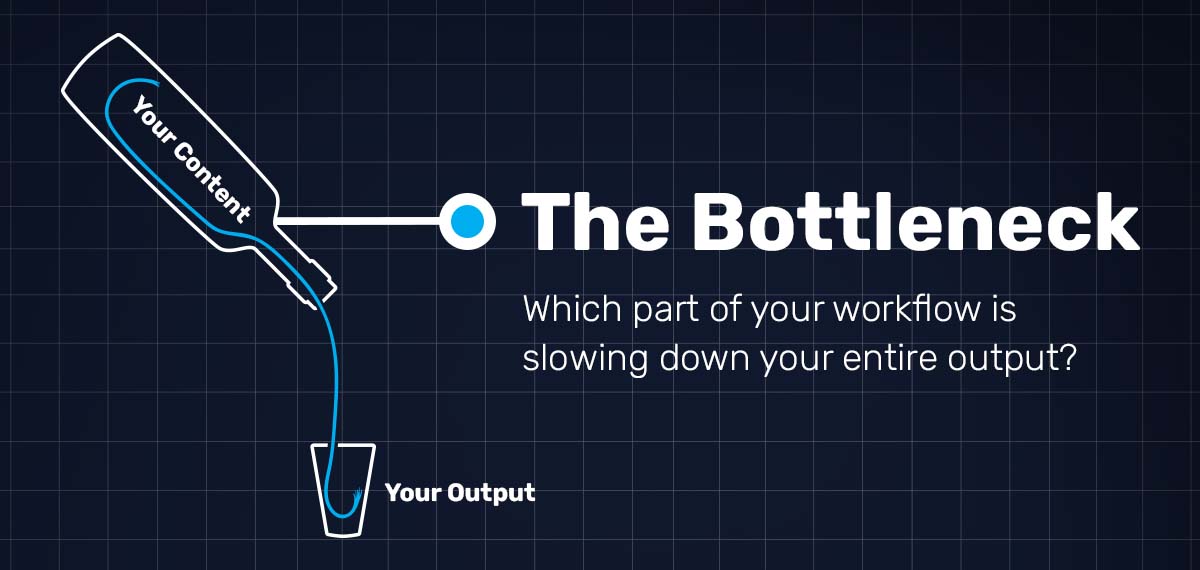
A content bottleneck is the exact stage in your production cycle where output drops and operational friction peaks. High-friction tasks drain your resources before you finish the final asset. You must locate these structural failure points to repair your system. If you ignore them, even the best content strategy will eventually collapse under the daily production workload.
Decision fatigue occurs when you make identical production choices repeatedly. Choosing thumbnail layouts, structuring scripts, searching for overlay assets, or rebuilding your editing timeline from scratch every session wastes valuable time. Every undocumented step in your workflow directly decreases your production capacity. A clear audit isolates these friction points before they become systemic.
Use this operational audit to locate your current workflow bottlenecks:
- Time Allocation: Which specific production step takes disproportionately long compared to its final output value?
- Repetitive Decisions: Which design or structural choices do you rebuild from scratch for every video or stream session?
- Task Resistance: Which exact phase – editing, scripting, thumbnail creation – causes the most friction before you start working?
- Asset Dependencies: Where does your pipeline stop completely because you lack a specific file, template, or tool?
The Manabrand Framework:
Building Your Production Engine
A production engine is a standardized workflow that converts raw ideas into published assets with minimal friction. You eliminate guesswork from your daily operations to build a sustainable channel. This framework separates creative ideation from technical execution across four building blocks.
Standard Operating Procedures (SOPs)
An SOP is a strict, step-by-step checklist for a recurring production task. You create SOPs to systematize your daily decision-making process. Document every stage of your production – from initial camera and microphone setup to final SEO metadata entry and stream configuration. This structural preparation allows you to execute complex tasks consistently without draining your cognitive resources before the actual creative work begins.
Task Batching
Task batching is the consolidation of identical production phases into a single focused work session. Switching between scripting, recording, and editing constantly destroys your momentum. A practical example for a gaming video creator: write four video scripts on Monday, record all four on Tuesday, and edit in two dedicated sessions later in the week. For streamers, batching applies to pre-production – preparing overlays, stream titles, and segment structures for multiple broadcasts in a single session rather than rebuilding the setup before every go-live.
Centralized Asset Libraries
An asset library is a structured database of your pre-approved brand elements. You never start a new project with a blank timeline or empty document. For gaming video creators this means organized folders of video templates, color-graded intros, branded lower thirds, and proven hook structures. For streamers it includes scene collections, alert presets, overlay variants, chat bot commands, and reusable panel graphics. You use this centralized system to eliminate creative friction and guarantee consistent brand quality across every format.
The ROI of Outsourcing
Strategic outsourcing is the delegation of high-friction tasks once your channel generates sustainable revenue. Treat your operation as a business and calculate the objective hourly value of your time. For gaming creators, the first outsourcing decisions typically involve thumbnail design, video editing, or clip cutting for Shorts and TikTok. If you earn professional income from your channel, spending ten hours on technical repetition instead of high-level content strategy creates a direct financial bottleneck. Reinvest your revenue to buy back time and focus exclusively on core brand growth and creative output.
The 4-Phase Production Pipeline: Structuring Your Workflow
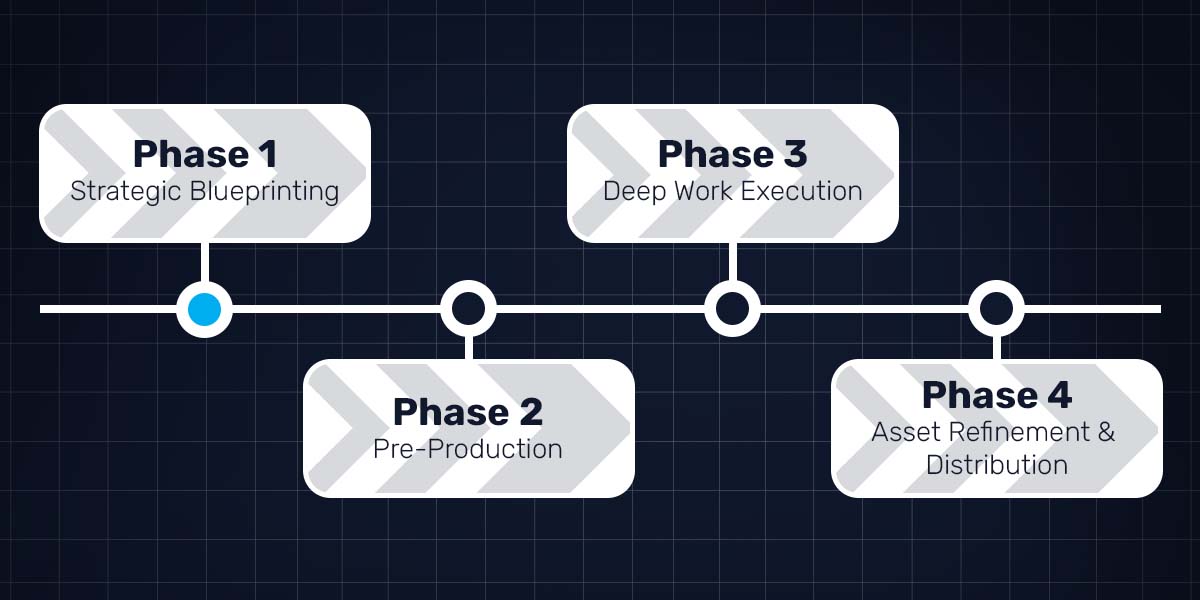
A production pipeline is the exact chronological sequence of your content creation process. You divide your workload into strictly separated operational phases. Mixing creative brainstorming with technical editing destroys your workflow momentum. This four-phase model builds a predictable and scalable content engine for both video creators and streamers.
Phase 1: Strategic Blueprinting
- Strategic Objective: Collect and validate content ideas systematically before any production begins.
- Operational Process: Dedicate specific time blocks to analyze trending games, upcoming patch cycles, tournament schedules, and keyword demand. Log validated concepts into a central content database. Strictly separate idea generation from writing or recording – decisions made here define the entire downstream production.
Phase 2: Pre-Production
- Strategic Objective: Build the structural blueprint for your chosen content.
- Operational Process: Write full video scripts or stream segment outlines. Prepare visual templates, configure technical setups, and gather necessary research data before recording begins. For streamers this phase includes scene preparation, title and category planning, and segment structuring for the upcoming broadcast.
Phase 3: Deep Work Execution
- Strategic Objective: Produce raw material with maximum focus and zero context switching.
- Operational Process: Deep work is the state of uninterrupted, single-task concentration – no notifications, no multitasking, no administrative overhead. For gaming video creators this means batch-recording multiple videos in a single session. For streamers it means treating the live broadcast as an isolated execution block – the Broadcaster mindset and the Editor mindset stay strictly separated. You protect this phase above all others because it is where your core content asset is created.
Phase 4: Asset Refinement & Distribution
- Strategic Objective: Finalize the asset and deploy it systematically across your platforms.
- Operational Process: Edit raw footage using your standardized templates, balance audio, remove dead air, and produce thumbnails from your pre-built design framework. Write SEO metadata and schedule uploads based on your strategic content calendar. For streamers, this phase includes VOD processing, clip selection, and repurposing footage for Shorts or social distribution – covered in detail in the next section.
The VOD Multiplier:
Turning One Stream into Multiple Assets
A single live broadcast is not a single content asset. It is a raw production session that generates multiple publishable formats when processed through a systematic workflow. Most streamers treat VODs as passive archives. Professional gaming creators treat every stream as the starting point of a multi-platform distribution cycle.
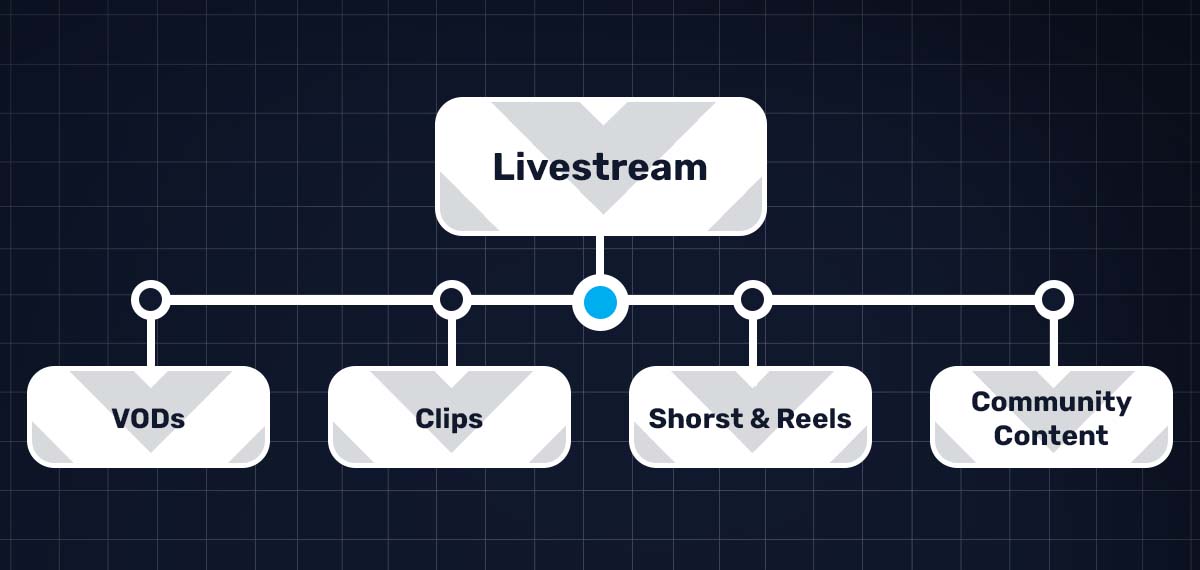
This is the VOD Multiplier framework:
- Live Broadcast: The primary asset. Delivered to your live audience on Twitch, YouTube Live, or Kick. This is your Deep Work Execution phase in real time.
- VOD: The broadcast becomes a permanent on-demand asset. Edited VODs with chapters and optimized titles function as standalone YouTube videos and extend your content's reach beyond the live audience.
- Clips: High-value moments – standout plays, reactions, key information segments – are extracted immediately after the broadcast. These clips serve as social proof and discovery content across Twitter/X, Instagram, and TikTok.
- Shorts & Reels: Vertical clips cut from the broadcast feed directly into the short-form algorithm on YouTube Shorts and TikTok. One broadcast can generate three to five Shorts with minimal additional production time.
- Community Content: Stream highlights, poll results, or recurring segment moments become Discord posts, community tab updates, or newsletter material.
One four-hour broadcast, processed through this framework, produces a full week of multi-platform content. The key operational requirement is a standardized clipping and editing checklist – an SOP that your editor or you execute identically after every stream. Without the system, the raw material sits unused in your VOD archive.
Conclusion: Professional Systems
Protect the Creator
A scalable content workflow is the operational line between a hobbyist gaming channel and a professional brand. You build standard operating procedures, batch your production tasks, centralize your assets, and process your VODs systematically to remove friction from every stage of your pipeline. This approach secures consistent output and protects your audience retention regardless of external platform pressure.
The most optimized production engine remains worthless if the creator breaks. You are the central asset of your entire operation. Strategic workflows exist to buy back your time and protect your cognitive resources – not to force endless production cycles. If you experience systemic exhaustion despite a structured pipeline, pause operations and prioritize your physical and mental health above upload schedules. A burned-out creator produces zero long-term value.
Start today: audit your current production pipeline, identify your primary bottleneck, and write your first SOP. The Content Creation hub covers the full framework – from workflow structure to platform-specific production strategies.

Lukas Adams
Media Designer, Online Marketing Manager | Founder of Manabrand
Lukas Adams is a certified Media Designer and Online Marketing Manager with over six years of experience in digital media and marketing. He specializes in digital brand architecture, web design, and content marketing. He founded Manabrand to provide digital creators with repeatable infrastructure blueprints instead of generic motivational advice. His objective is to reverse-engineer industry success into actionable, long-term operational systems.
Related Articles
How to Find Your Gaming Creator Niche
Most gaming creators fail for the same reason: they never define what they actually make. Talent and consistency are not enough without a clear content direction. This guide breaks down how to find a gaming niche with real demand, low saturation, and a defensible position, built through market analysis, language-market gaps, and content-type matching.
How to Start Creating Gaming Content: Your First Steps
Most beginners buy equipment before deciding what to create or where to publish it. This guide covers the four decisions that come first: content type, platform, niche timing, and channel setup.