

Why Talent Alone Doesn't Build a Channel
Most new gaming creators are not lacking skill. They are lacking direction.
They can edit, they can talk on stream, they show up consistently, and the channel still doesn't grow. The reason is structural, not personal: without a defined niche, every upload competes in a different category, against a different audience, with a different set of competitors. Growth becomes accidental instead of compounding.
A niche is not a creative limitation. It is a market position: a specific space where demand exists, competition is manageable, and the creator has a genuine reason to be there. Finding it is a research process, not a personality test.
This article treats niche selection as what it is: a business decision. It walks through market analysis, unique positioning, an often-overlooked language-market advantage, and how to match a niche to the right content type.
Key Takeaways
- Market position: A niche is a market position, not a personality trait. It can be analyzed and chosen deliberately.
- Two-sided analysis: Demand and supply must be checked separately. High demand with high supply is still a hard market to enter.
- Personal fit: Market signals only matter if the creator has genuine, lasting interest and knowledge in the niche.
- Differentiation: A unique angle (USP) is what separates a niche from a copy of an existing channel.
- Language gap: Non-English markets are frequently underserved even when the English-language version of the same niche is saturated.
- Format fit: Content type must match both the niche and the creator's realistic production capacity.
- Validation: A niche should be validated with small tests before full commitment, and checked for long-term viability beyond a single game or trend.
- → What "niche" actually means in gaming content
- → Market analysis: demand vs. supply
- → Personal fit: can you sustain this niche
- → Finding your unique angle (USP)
- → The language advantage: underserved native-language markets
- → Choosing your content type
- → Validating your niche before committing
- → Common mistakes when choosing a niche
What "Niche" Actually Means in Gaming Content
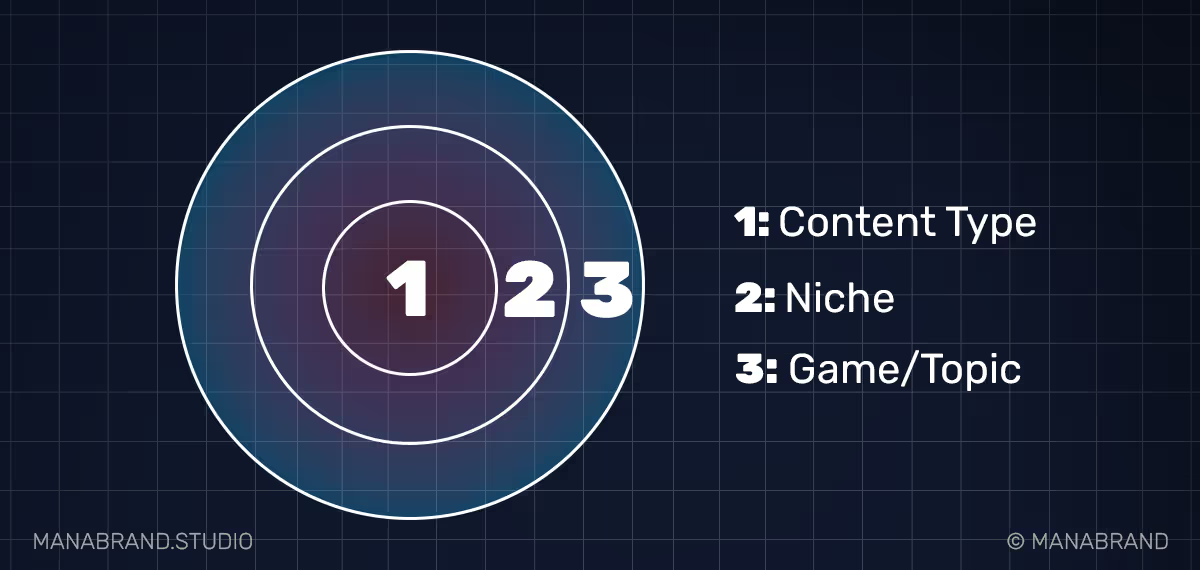
A niche is the specific intersection of game, format, and audience a creator serves, not the game itself.
"Fortnite" is not a niche. "Competitive Fortnite analysis for aspiring ranked players" is. The game is the topic. The niche is the angle, the format, and the audience the content is built for.
Three terms get mixed up constantly, and separating them clears up most of the confusion:
- Game/Topic: The subject matter (a specific title, genre, or gaming category).
- Niche: The specific angle within that topic, defined by audience and content type.
- Content Type: The format used to deliver the niche (guide, Let's Play, commentary, competitive VOD review).
A creator can change games and keep the same niche (e.g., "beginner-friendly ranked guides," applied across different competitive titles). A creator can also keep the same game and fail to have a niche at all, by covering it the same way as thousands of others.
Market Analysis: Demand vs. Supply
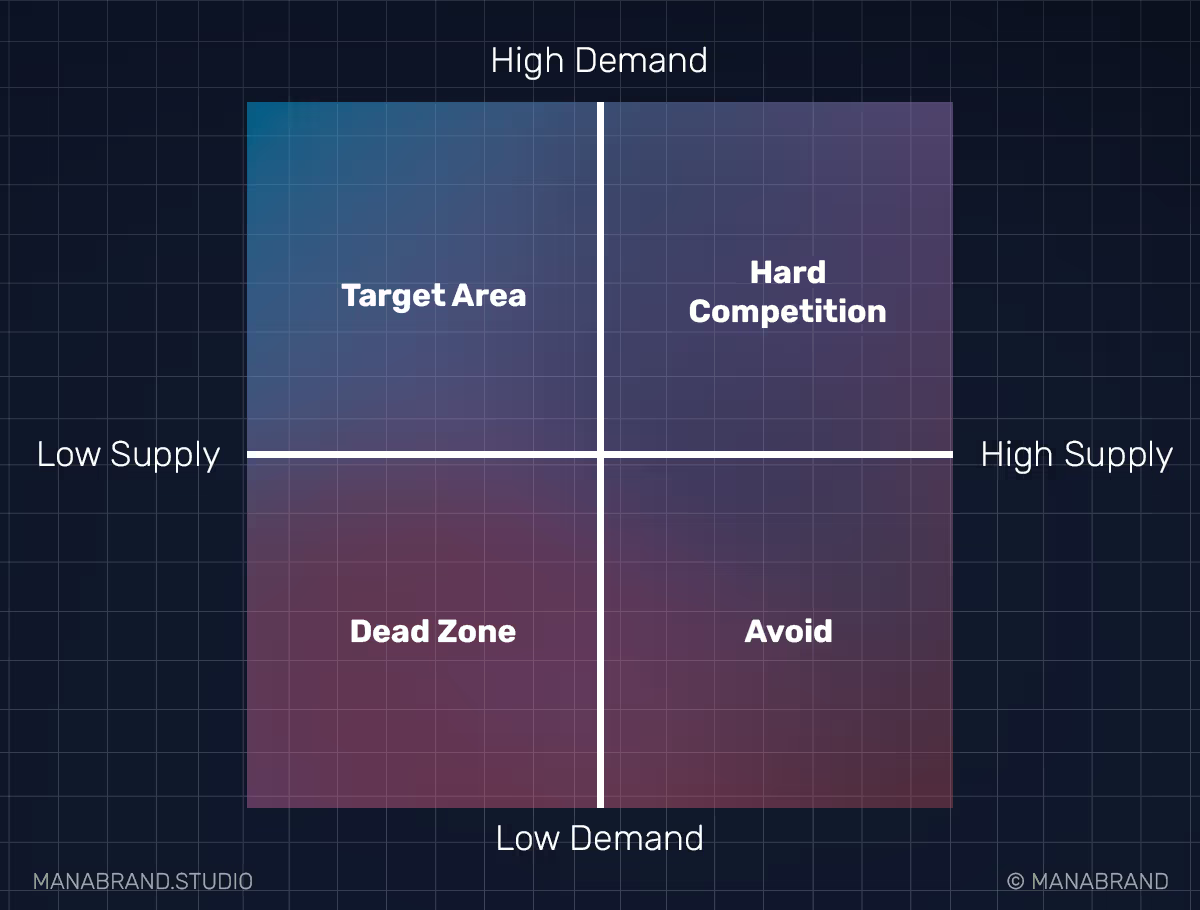
Demand and supply describe two separate market forces, and treating them as one question is the most common analytical mistake in niche selection. A niche can look attractive on the demand side and still be a poor choice once the supply side is checked. The two signals only carry meaning in combination.
Reading Demand Signals
Demand is measurable before a single video is published. Skipping this step is the most common reason creators pick a niche that never grows.
- Search volume: Use tools like Google Trends or a keyword planner to check if people actively search for the topic.
- Community size: Subreddit size, Discord member counts, and Steam community activity indicate an active audience, not just interest.
- Platform trend data: YouTube and Twitch category growth (rising vs. declining viewer hours) shows where attention is currently moving.
- Comment patterns on existing content: Recurring questions in comment sections reveal unmet demand directly.
None of these signals is reliable in isolation. A high search volume with no active community, for example, often points to seasonal or one-off interest rather than a niche with staying power. The strongest demand signals appear when search interest, community activity, and platform trend data all point in the same direction.
Mapping the Supply Side
Where demand analysis asks whether an audience exists, supply analysis asks how hard it will be to reach that audience. A niche with strong demand and a thin, low-quality supply side is a rare and valuable opportunity; the same demand paired with an already professional, oversaturated supply side is a much harder market to enter.
- Category density: How many channels actively publish in this exact niche, not just this game.
- Quality ceiling: Is the existing content low-effort, or already highly professional? A low ceiling is an opportunity; a high ceiling requires a stronger USP.
- Upload frequency of competitors: Consistent daily uploads from established channels signal a hard market to break into.
- Freshness of the format: Content types that haven't been tried yet within a popular game often carry lower competition, even in a saturated topic.
Reading these four signals together produces a realistic difficulty score for a niche, long before a single video is uploaded. A niche with high demand and low supply density is the ideal target. High demand paired with high supply density is not automatically disqualifying, but it does require a stronger, more specific USP than a niche that is still relatively empty.
Useful sources for this analysis: Google Trends, Steam Charts, the Twitch category browser, subreddit and Discord activity, and direct competitor upload histories.
Personal Fit: Can You Sustain This Niche
Market analysis answers whether an audience exists. It does not answer whether the creator has the knowledge and interest to stay in that niche for years.
A niche can score well on every market signal and still be the wrong choice, if the creator only has surface-level interest in the topic. Short-term motivation, often driven by a trend or a single popular game, rarely survives the slow, unglamorous early phase every niche goes through before it gains traction. Long-term interest does.
Testing personal fit before committing is straightforward. Three questions separate a durable niche choice from a trend-driven one:
Self-check:
- Existing knowledge or experience: does the creator already understand this topic, or would they need to learn it from zero alongside the audience?
- Interest independent of outcome: would the creator still engage with this topic if the channel grew slowly for the first six months?
- Willingness to specialize: can the creator commit to this angle repeatedly, instead of switching topics every few weeks?
This check works alongside the market analysis, not instead of it. A niche with strong market signals and weak personal fit still carries high burnout risk. A niche with strong personal fit and weak market signals still struggles to grow. The two need to overlap.
Finding Your Unique Angle (USP)
Personal fit confirms a creator can sustain a niche. A USP (Unique Selling Proposition or Unique Selling Point) defines why this creator, specifically, should own it.
Two channels can share the exact same niche and have completely different USPs: one might build authority through technical depth, another through personality and entertainment value, another through production quality. Choosing a niche without defining the USP results in a channel that is functionally a copy of an existing one.
Self-check:
- What can this creator explain, demonstrate, or entertain with that existing channels in this niche do not?
- What background, skill, or perspective is genuinely difficult for a competitor to replicate?
- If a viewer had to choose between this channel and the closest competitor, what is the one reason to choose this one?
A USP does not need to be dramatic. Consistency, a specific skill level (e.g., "for absolute beginners"), or an unusual technical angle (e.g., a coaching background) is enough to differentiate, as long as it is stated clearly and repeated across content, not left implicit.
The Language Advantage: Underserved Native-Language Markets
The English-language gaming content market is the most saturated in the world. It is also not the only market.
A niche that is fully saturated in English can be nearly empty in another native language, for the same game, the same format, and the same relative audience size. Non-native English speakers frequently default to producing English content because it appears to reach a larger audience, without checking whether that larger audience is already served by hundreds of existing channels.
These Signals Matter
Competitor density
English-Language Market:
Often extremely high for popular titles
Non-English Market:
Frequently low to moderate
Community size
English-Language Market:
Large, but fragmented across many channels
Non-English Market:
Smaller, but concentrated around fewer creators
Guide/tutorial coverage
English-Language Market: Usually comprehensive, multiple creators per topic
Non-English Market: Often outdated, incomplete, or missing entirely
Monetization competition
English-Language Market: High CPC competition, harder ad and sponsor visibility
Non-English Market: Lower competition, easier local sponsor access
This is not a suggestion to abandon English content. It is a prompt to check, deliberately, whether the same niche is underserved in a creator's native language before defaulting to English by habit. A smaller but concentrated audience with low competition frequently outperforms a large but fragmented one.
Choosing Your Content Type
A niche without a matching content type is not usable. The format has to fit both the niche and the creator's actual production capacity.
Matching Format to Skillset and Niche
Content type is not a stylistic preference. It is a structural decision based on demand type, required production skill, and the amount of time a creator can realistically sustain. A niche does not dictate a single content type. Most niches can be served through more than one format, and the right choice depends on which production effort matches the creator's available time and current skill level. Here are some examples:
Let's Play / Playthrough
Best for:
Personality-driven audiences, narrative games
Production Effort:
Low–Medium
Typical Demand:
High, but format-saturated
Competitive Density:
Very High
Analysis / Commentary
Best for:
Meta-games, competitive scenes, patch discussions
Production Effort:
Medium–High
Typical Demand:
Medium, trend-sensitive
Competitive Density:
Medium
Competitive / Esports Coverage
Best for:
Ranked players, esports-adjacent audiences
Production Effort:
High
Typical Demand:
Medium, narrow but loyal
Competitive Density:
Low-Medium
Guides / Tutorials
Best for:
Skill-based niches, ranked or mechanically deep games
Production Effort:
Medium
Typical Demand:
High, evergreen
Competitive Density:
Medium
Variety / Entertainment
Best for:
Personality-first channels, no fixed game
Production Effort:
Low–Medium
Typical Demand:
High, hard to rank on search
Competitive Density:
High
The table above is a starting point, not a final decision. A creator with strong editing skills and limited time on camera may be better served by tutorial-style guides than by high-frequency Let's Play content, even within the same niche. The goal is to match production effort to actual capacity. A content type that cannot be sustained consistently will undermine an otherwise well-chosen niche faster than the niche itself ever could.
A detailed breakdown of production workflows and quality benchmarks for each format is covered separately in the Content Creation Workflow guide. This section covers only the strategic fit between niche and format, not execution.
Validating Your Niche Before Committing
A niche is a hypothesis until it is tested. Full commitment before validation is a common and avoidable mistake.
Testing Before Full Commitment
- Run a small content batch: 3–5 pieces in the target niche before building a full content calendar around it.
- Track direct signals: Click-through rate, average view duration, and comment engagement, not just view count.
- Watch for audience mismatch: A video performing well but attracting the wrong audience (based on comments and community feedback) signals a niche or angle problem, not a production one.
- Set a defined observation period: 4–6 weeks of consistent output is enough to read a real trend, rather than reacting to a single outlier video.
Validation and longevity answer two different questions. Testing confirms whether a niche performs with a real audience today. Checking for longevity confirms whether that performance is likely to hold up over time, independent of a single game's popularity or a passing trend. Skipping the second question is how creators end up rebuilding their niche every six months.
Checking for Longevity
- Game-dependent niches (e.g., a single title's meta) carry the risk of disappearing when the game's player base declines.
- Format-dependent or skill-dependent niches (e.g., ranked coaching, technical breakdowns) tend to transfer across multiple games and outlast individual trends.
A niche that can realistically sustain content for 2+ years, independent of a single game's lifecycle, carries significantly lower long-term risk. This is the market side of longevity. Personal fit, covered earlier, is the creator side: a niche only holds up long-term if both the market and the creator can sustain it.
Common Mistakes When Choosing a Niche
The mistakes below are structural, not tactical. They tend to repeat across otherwise different channels making the same underlying decision-making error.
- Copying a successful channel's niche without a distinct USP: same niche, same angle, same failure to differentiate.
- Chasing trends instead of demand: a trending topic with a two-week lifespan is not a niche, it is a spike.
- Ignoring the supply side: high demand does not matter if 500 channels already cover it at a high production level.
- Defaulting to English without checking native-language demand: skipping a potentially underserved, lower-competition market by habit.
- Choosing a content type that doesn't match production capacity: a high-effort format without the time or skill to sustain it leads to inconsistent output.
- Treating niche selection as permanent: a niche can be refined based on validation data. It does not have to be right on the first attempt.
Next Step
Finding a niche defines what a creator makes. It does not define how that content gets packaged, recognized, and remembered by an audience. That's a branding problem, covered in Gaming Creator Branding 101, which builds the visual and structural identity around the niche established here.

Lukas Adams
Media Designer, Online Marketing Manager | Founder of Manabrand
Lukas Adams is a certified Media Designer and Online Marketing Manager with over six years of experience in digital media and marketing. He specializes in digital brand architecture, web design, and content marketing. He founded Manabrand to provide digital creators with repeatable infrastructure blueprints instead of generic motivational advice. His objective is to reverse-engineer industry success into actionable, long-term operational systems.
Related Articles
How to Start Creating Gaming Content: Your First Steps
Most beginners buy equipment before deciding what to create or where to publish it. This guide covers the four decisions that come first: content type, platform, niche timing, and channel setup.
Gaming Content Workflow: Building a Scalable Production Engine for Video Creators and Streamers
In a market where upload frequency, production quality, and platform consistency determine channel growth, relying on daily motivation is a structural liability. Gaming video creators and streamers who want to build sustainable channels replace raw effort with standardized production pipelines.