

What Platform Independence Actually Means for Gaming Creators
Platform independence does not mean leaving Twitch or YouTube. It means not being exclusively dependent on them. The distinction matters, because both platforms remain essential. They are where new audiences discover creators. The problem is not the platforms themselves. The problem is treating them as the final destination instead of the starting point.
A platform-independent creator uses Twitch and YouTube as acquisition channels. They convert that audience into relationships they own – on infrastructure they control. This is the structural difference between a creator with 50,000 followers and no owned audience, and a creator with 10,000 followers and a direct line to every one of them.
Ownership in this context means control over the channel, the contact list, and the communication – independent of any platform's algorithm, monetization policy, or terms of service.
Key Takeaways
- Discovery vs. retention: YouTube and Twitch acquire audiences. Owned channels retain them. These are two different functions that require two different tools.
- Owned media: True owned media means controlling the infrastructure: your website, your domain, your email list. No platform decision can remove that access.
- Discord: Valuable as community infrastructure, but not owned media. Discord reduces algorithmic dependency without eliminating platform risk.
- Sequencing: Build in order: community first (Discord), foundation second (website), direct access third (newsletter). Each layer adds retention depth.
- Migration risk: A creator without owned media has no fallback when a platform changes its rules. A creator with owned media has continuity.
The Risk Every Gaming Creator Is Carrying
Platform risk is not hypothetical – it is documented. Twitch has restructured its revenue split for established streamers, cutting partner payouts without negotiation. YouTube has run repeated demonetization waves that removed ad revenue from gaming content overnight, often with no clear criteria and no appeal window. DMCA enforcement – rooted in US copyright law, but applied globally via platform policy – wiped entire VOD libraries, taking years of content with it. In each case, creators with no owned audience had no fallback.
The mechanism behind this risk is structural. When a creator builds exclusively on a platform, three things happen simultaneously: the platform controls discoverability, the platform controls monetization, and the platform mediates the relationship between creator and audience. Remove any one of those three, and the creator's business model breaks.
This is not an argument against using platforms. It is an argument against treating them as infrastructure. Twitch and YouTube are tools for reaching audiences – not for owning them.
Discovery Engines vs. Retention Tools:
Two Different Jobs
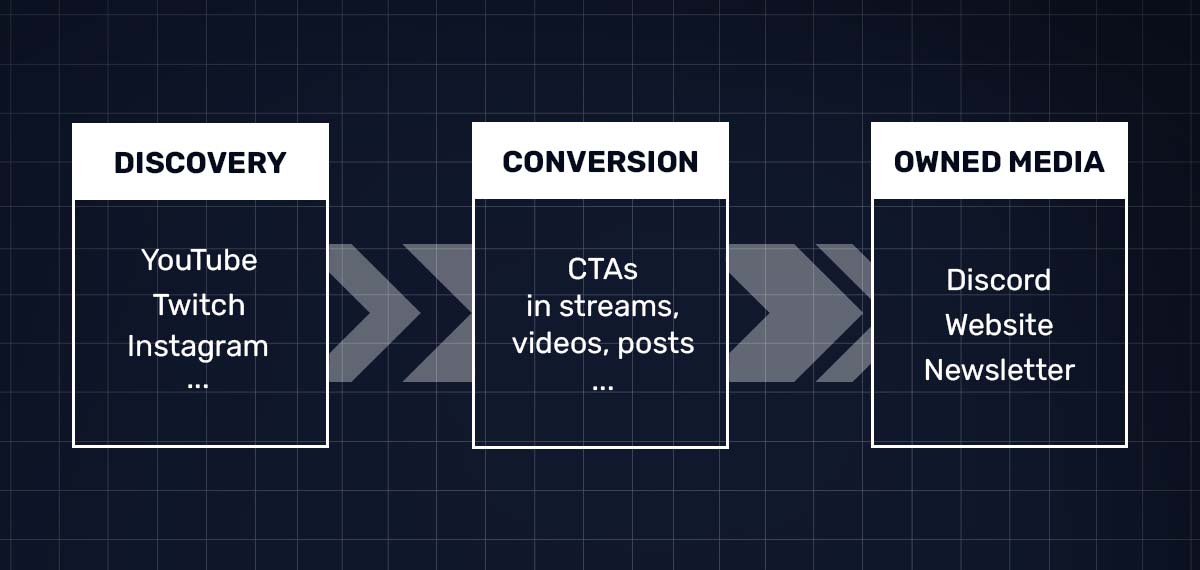
YouTube and Twitch are discovery engines. Their core function is connecting content with new audiences through algorithmic distribution. They are exceptionally good at this – and that is exactly why creators should use them. But discovery is not retention. A viewer who finds a stream on Twitch and watches for an hour has not joined an audience. They have had a single interaction with a platform.
Retention is a different function entirely. It requires a channel where the relationship persists beyond a single session – where the creator can reach the audience directly, without competing in a feed, and without depending on an algorithm to surface the message. Discovery engines do not provide this. They are optimized for reach, not for relationship depth.
The strategic error most gaming creators make is using discovery engines for both jobs. They optimize for growth on Twitch and YouTube and assume that follower counts represent audience ownership. They do not. A creator with 100,000 Twitch followers and no owned channel has no guarantee that any of those 100,000 people will see their next piece of content.
Owned Media: What Gaming Creators Actually Use
Owned media is any channel where the creator controls the infrastructure, the contact list, and the communication – independently of a third-party platform. In the gaming creator space, this breaks into two categories: channels you truly own, and community infrastructure that reduces platform dependency without replacing ownership.
Your own website
The domain belongs to you, the content belongs to you, and no platform policy can remove it. A creator website functions as a content hub, an SEO asset, and a permanent home base outside any platform's ecosystem. In the gaming space, creator-owned sites are culturally established – from independent wikis to personal content archives. A website does not replace platforms. It gives the creator a presence that no platform decision can affect.
An email list and newsletter
Every subscriber on an email list has actively chosen to receive communication from the creator. There is no algorithm determining who sees the message, no feed competing for attention, and no platform intermediary in the relationship. Email open rates consistently outperform organic platform reach – not because email is a better content format, but because it is a direct channel. The newsletter is the operational form of the email list: a regular, structured communication that gives the audience a reason to stay subscribed. Creators in the gaming space use newsletters for patch notes and meta updates, community roundups, early access to content, and exclusive analysis.
True owned media requires infrastructure the creator controls: a self-hosted or independently operated website, and an email list where the creator owns the data export. These are the two assets that survive any platform decision.
Discord: Community Infrastructure –
Not Owned Media
Discord
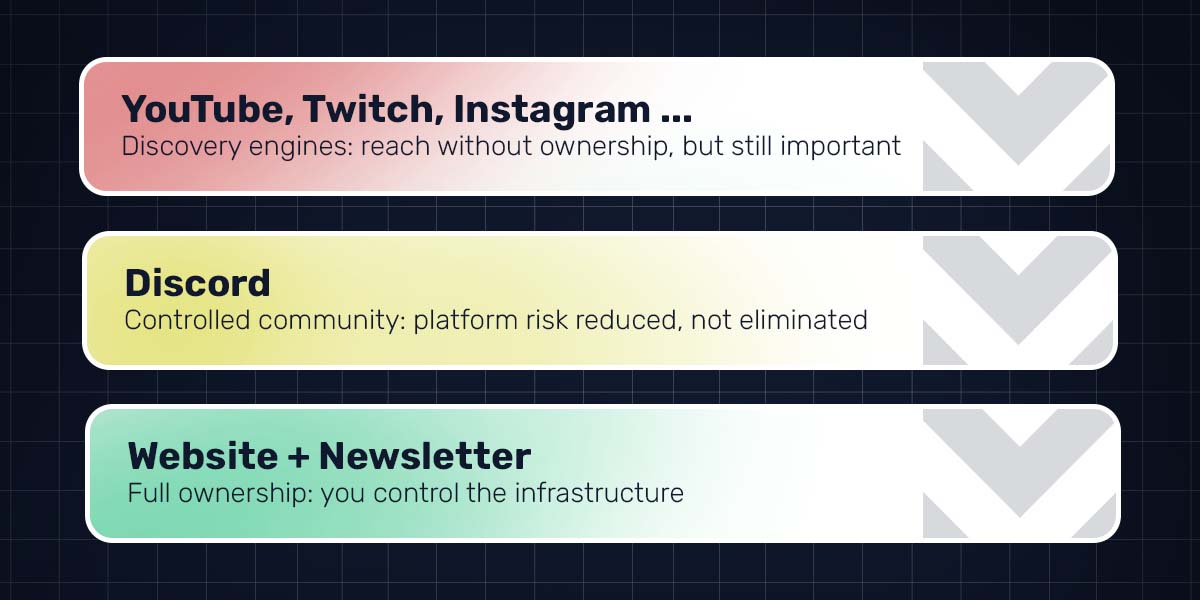
Discord is not owned media. The creator operates a server on Discord's infrastructure. Discord can change its terms of service, restructure its platform, or cease to exist. The structural risk is real, and it belongs in the same category as Twitch or YouTube.
That said, Discord is still meaningfully different from a discovery platform – and the difference matters strategically. There is no algorithm controlling who sees what inside a Discord server. Communication is direct and synchronous. The community exists independently of content output – members remain in the server whether or not the creator posts that week. And the relationship depth possible in a Discord community is qualitatively different from a follower relationship on a discovery platform.
Discord reduces algorithmic dependency without eliminating platform risk. For gaming creators, it is the most natural entry point into community building. The format is familiar to the audience, the barrier to joining is low, and the community dynamics it enables – voice channels, role-based access, real-time interaction – align directly with how gaming communities operate.
The strategic recommendation is to use Discord as community infrastructure while building toward true owned media in parallel. A Discord community is not a substitute for a website or an email list. It is the first layer of a retention strategy and an active, well-structured Discord server is the strongest possible incentive for newsletter signup. Discord creates the relationship, the email list secures it.
How to Start Building Your Owned Audience as a Gaming Creator
Platform independence is built in sequence, not simultaneously. Attempting to launch a Discord server, a website, and a newsletter at the same time produces three underdeveloped channels instead of one functional one. The correct approach is to build one layer at a time, in order of accessibility and immediate value.
Community: Discord
Lowest barrier to entry. Familiar to a gaming audience. Build channel structure, establish purpose, and connect directly to your existing platform presence via stream overlays and video descriptions.
Foundation: Website
A content hub with a clear value proposition, a portfolio of work, and an email signup form is sufficient at launch. Begins building the SEO asset that compounds over time.
Direct access: Newsletter
The most valuable layer, built last. Start simple: one piece of original content, one community update, one external resource. Consistent cadence matters more than volume.
Each phase feeds the next. Discord builds the relationship. The website builds the foundation. The newsletter secures the direct line. Together, they form an owned audience that no platform decision can remove.
Platform Independence Is Not Optional –
It Is Infrastructure
Every gaming creator who builds exclusively on third-party platforms is running a business on someone else's foundation. That foundation can shift at any time – and when it does, creators without owned channels have no continuity, no fallback, and no direct relationship with the audience they spent years building.
Platform independence is not a growth strategy. It is risk management. It is the structural decision to treat YouTube and Twitch as tools for acquisition while building the channels that actually retain the audience. Discord, a website, and an email list are not replacements for platforms – they are the infrastructure that makes a platform-dependent project into a sustainable one.
The creators who survive platform changes are not the ones with the most followers. They are the ones who converted those followers into an audience they own.

Lukas Adams
Media Designer, Online Marketing Manager | Founder of Manabrand
Lukas Adams is a certified Media Designer and Online Marketing Manager with over six years of experience in digital media and marketing. He specializes in digital brand architecture, web design, and content marketing. He founded Manabrand to provide digital creators with repeatable infrastructure blueprints instead of generic motivational advice. His objective is to reverse-engineer industry success into actionable, long-term operational systems.
Related Articles
How to Find Your Gaming Creator Niche
Most gaming creators fail for the same reason: they never define what they actually make. Talent and consistency are not enough without a clear content direction. This guide breaks down how to find a gaming niche with real demand, low saturation, and a defensible position, built through market analysis, language-market gaps, and content-type matching.
Gaming Content Workflow: Building a Scalable Production Engine for Video Creators and Streamers
In a market where upload frequency, production quality, and platform consistency determine channel growth, relying on daily motivation is a structural liability. Gaming video creators and streamers who want to build sustainable channels replace raw effort with standardized production pipelines.